Have you ever searched for a product on Google and noticed that the first few results were marked as “Sponsored”? Or maybe you’ve scrolled through Instagram and seen an advertisement for a pair of shoes you were just talking about with your friends. If you’ve watched a YouTube video and a brand promotion appeared before it started, you’ve already experienced digital marketing in action.
Whether we realize it or not, digital marketing has become part of our everyday lives. From the moment we unlock our phones in the morning until we put them away at night, we’re constantly interacting with brands online. Businesses know this, which is why they’re investing more in digital platforms than ever before.
For students, job seekers, entrepreneurs, and business owners, digital marketing has become one of the most valuable skills to learn. It’s not just a trend—it’s a field that’s growing rapidly and creating thousands of career opportunities every year. If you’re wondering what digital marketing actually is and why everyone is talking about it, this guide is the perfect place to start.
So, What Exactly is Digital Marketing?
In simple words, digital marketing is the process of promoting a business, product, or service using the internet and digital platforms. Instead of relying only on newspapers, television, radio, or billboards, businesses now use websites, search engines, social media, emails, and mobile apps to reach potential customers.
Imagine you own a bakery in Kochi. A few years ago, you might have advertised in the local newspaper or distributed flyers around the neighborhood. Today, you can post pictures of your cakes on Instagram, run Facebook ads targeting people nearby, appear on Google when someone searches for “birthday cakes near me,” and even send discount offers through email or WhatsApp. That’s digital marketing.
The biggest advantage is that businesses can connect with the right audience at the right time. Rather than showing an advertisement to everyone, digital marketing allows companies to target people based on their location, age, interests, online behaviour, and even previous purchases. This makes marketing much more effective and often more affordable than traditional advertising.
Why Has Digital Marketing Become So Important?
Take a moment to think about your own habits. Before buying a mobile phone, choosing a restaurant, booking a hotel, or joining a course, what do you usually do?
Most people start with a Google search. They read reviews, compare prices, watch YouTube videos, check Instagram pages, and sometimes ask questions on social media before making a decision.
Businesses understand this change in customer behaviour. If they’re not visible online, they risk losing customers to competitors who are.
That’s why companies of every size—from local shops and restaurants to multinational brands—are investing in digital marketing. A strong online presence helps businesses build trust, attract new customers, and stay connected with existing ones. More importantly, it allows them to measure exactly what’s working. They can see how many people visited their website, clicked on an advertisement, watched a video, or made a purchase, making it easier to improve future campaigns.
The Different Parts of Digital Marketing
Digital marketing isn’t just one skill—it’s a combination of several strategies that work together.
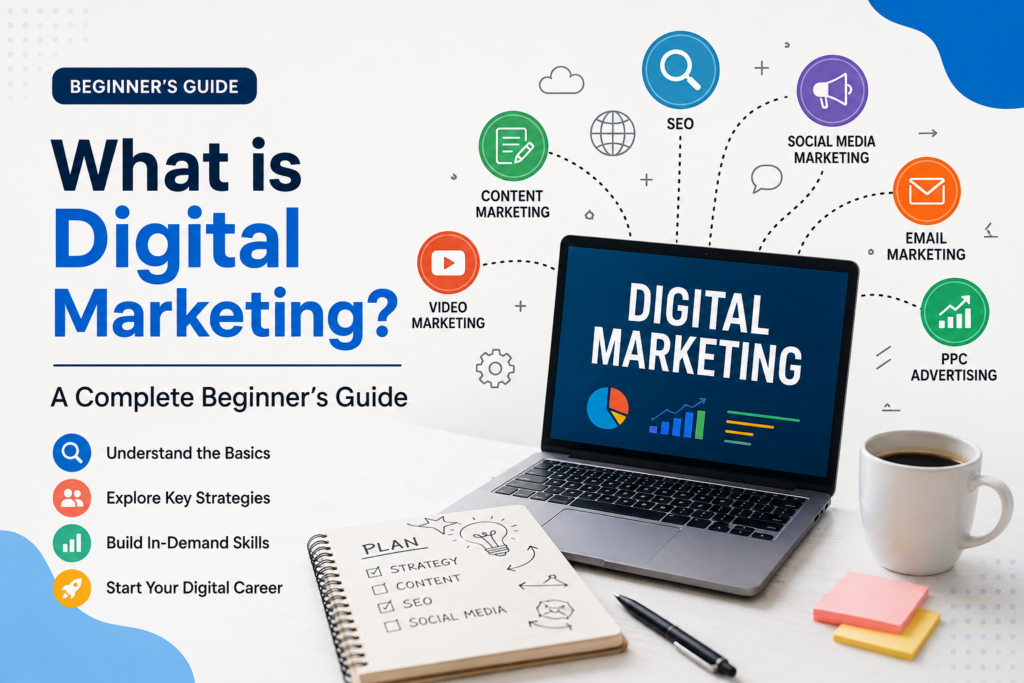
One of the most important areas is Search Engine Optimization (SEO). SEO helps websites appear higher in Google search results without paying for advertisements. When someone searches for “best graphic design course in Kerala,” businesses that have optimized their websites properly have a better chance of appearing on the first page. Since most users rarely look beyond the first few results, SEO can make a huge difference.
Another popular area is Search Engine Marketing (SEM), where businesses pay to display advertisements on Google. These sponsored ads appear above regular search results and help companies reach people who are already looking for their products or services.
Then there’s Social Media Marketing, which has become one of the most recognizable forms of digital marketing. Platforms like Instagram, Facebook, LinkedIn, and YouTube allow businesses to connect directly with their audience by sharing engaging content, running advertisements, and building online communities. A single creative post can sometimes reach thousands—or even millions—of people.
Content Marketing is another essential part of the digital marketing ecosystem. Instead of directly asking people to buy something, businesses create useful blogs, videos, guides, podcasts, and infographics that educate or solve problems. This builds trust over time, making customers more likely to choose that business when they’re ready to make a purchase.
Businesses also use Email Marketing to stay in touch with customers. Whether it’s a newsletter, a product update, or a special discount, email remains one of the most effective ways to build long-term relationships with an audience.
Paid advertising, often called Pay-Per-Click (PPC) marketing, allows businesses to pay only when someone clicks on their advertisement. Platforms like Google Ads and Meta Ads Manager make it possible to target highly specific audiences, ensuring that marketing budgets are spent efficiently.
Other growing areas include affiliate marketing, influencer marketing, video marketing, and marketing automation, all of which continue to create exciting opportunities for digital marketers.
Is Digital Marketing a Good Career?
Without a doubt, yes.
As businesses continue moving online, the demand for digital marketing professionals keeps increasing. Companies need people who understand how to improve their online visibility, attract customers, create engaging content, manage advertising campaigns, and analyze performance.
One of the biggest advantages of this field is its flexibility. You can work in a marketing agency, join a startup, become part of a corporate marketing team, or even work remotely as a freelancer. Some professionals choose to specialize in SEO, while others become experts in social media, paid advertising, content writing, or analytics.
Digital marketing also rewards continuous learning. The more skills you develop, the more valuable you become in the industry.
Skills You’ll Need
Many beginners think digital marketing is only about posting on Instagram or running Facebook ads, but it’s much broader than that.
A successful digital marketer understands customer psychology, writes compelling content, analyzes campaign data, and stays updated with changing trends. Creativity is important, but so is analytical thinking.
You’ll also work with tools like Google Analytics, Google Ads, Meta Ads Manager, Canva, WordPress, and SEO platforms. Recently, AI-powered tools have become an important part of the industry as well. They can help generate ideas, automate repetitive tasks, and improve productivity. However, AI is only a tool—the real value still comes from people who understand strategy, storytelling, and customer behaviour.
Career Opportunities After Learning Digital Marketing
Digital marketing opens the door to a wide range of careers. Depending on your interests, you could become an SEO Specialist, Social Media Manager, Content Writer, Performance Marketer, Google Ads Expert, Email Marketing Executive, Marketing Analyst, Digital Marketing Executive, or even a Digital Marketing Manager.
Many professionals also choose freelancing, working with clients from different cities or countries while enjoying flexible schedules. Some eventually launch their own digital marketing agencies or start successful online businesses using the skills they’ve learned.
The opportunities are not limited to one industry either. Healthcare, education, tourism, fashion, e-commerce, real estate, entertainment, finance, and technology companies all require digital marketing professionals.
Why Now Is the Best Time to Learn
The digital world is growing every day. Businesses are spending more on online advertising, consumers are shopping online more frequently, and new technologies continue to reshape the marketing industry.
Learning digital marketing today isn’t just about finding a job—it’s about preparing yourself for the future. Whether you dream of building your own business, becoming a freelancer, or working for a leading company, digital marketing gives you skills that are valuable almost everywhere.
The best part is that you don’t need a specific educational background to get started. With the right training, regular practice, and a willingness to keep learning, anyone can build a successful career in this field.
Learn Digital Marketing at Ozo School of Design
At Ozo School of Design, learning goes beyond classroom theory. Students work on real projects, create marketing campaigns, build websites, optimize content for search engines, and learn to run advertising campaigns using industry-standard tools. The focus is on practical experience because that’s what employers value the most.
From SEO and Google Ads to social media marketing, content creation, email marketing, analytics, and AI-powered marketing tools, the curriculum is designed to prepare students for today’s digital marketing industry. By the time they complete the course, students don’t just understand the concepts—they know how to apply them in real-world situations.
Final Thoughts
Digital marketing isn’t simply about advertisements or social media posts. It’s about understanding people, solving problems, building relationships, and helping businesses grow in an increasingly digital world. Every search on Google, every Instagram campaign, every email newsletter, and every YouTube advertisement is part of a much bigger strategy to connect brands with their audience.
As more businesses move online, the demand for skilled digital marketers will continue to rise. If you’re looking for a career that’s creative, dynamic, and full of opportunities, digital marketing is definitely worth exploring. Start learning, keep experimenting, stay curious, and remember—every expert was once a beginner.